
Vibrational Response: The Living Fiber
'Like the polyamide strings of a concert guitar, Pegasus Hair resonates with musical intention. Its molecular structure doesn’t merely grip the string — it participates in the vibration. The result is tone that breathes with warmth, clarity, and strength long after natural fibers fall silent.'
A bow is not merely a tool — it is an energy translator. Every note produced on a string instrument begins as stored mechanical energy in the bow hair, released and modulated by the player’s touch. The way that energy flows — how it is stored, transferred, and dissipated — defines a bow’s personality.
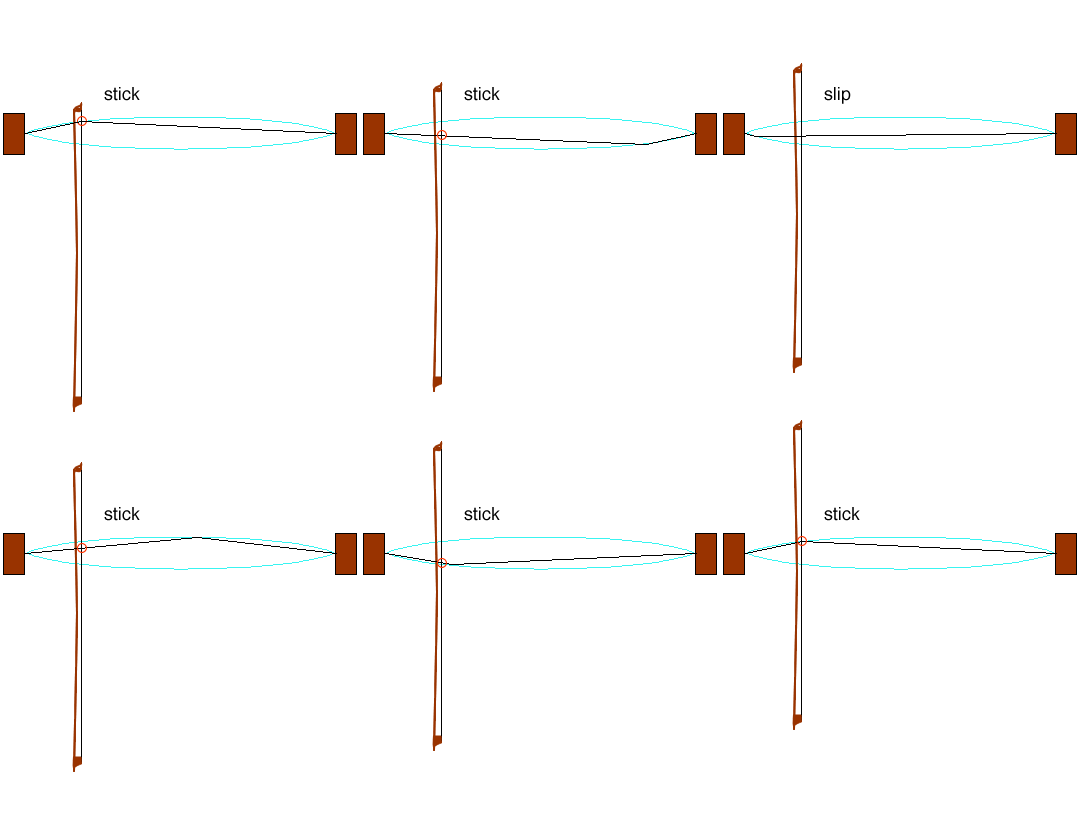
Horsehair has long been prized because its organic microstructure provides both elasticity and subtle internal damping. Yet, those same biological irregularities limit consistency and endurance: microscopic cracks, moisture absorption, and variable fiber stiffness all distort the vibrational energy path. Over time, this causes loss of articulation, tonal focus, and “spring.”
Pegasus Hair advances this fundamental physics through a controlled viscoelastic design. The biocomposite’s polymer matrix is engineered for a precise balance of elastic modulus and internal damping coefficient, optimized for energy return in the 200–4,000 Hz range — the harmonic bandwidth where bow–string interaction is most perceptible to the ear. In musical terms, this means Pegasus Hair “breathes” with the instrument, transmitting transient impulses more faithfully, while resisting the micro-slippage that dulls traditional hair after months of use.
Additionally, the uniform cylindrical geometry of each strand minimizes phase dispersion across the hair ribbon, allowing collective vibration modes to align coherently. This coherence yields greater projection, clarity of articulation, and an enhanced perception of focus under the ear. The absence of structural fatigue in the polymer backbone ensures that this response does not degrade over time — maintaining tonal brightness and resilience even after thousands of playing hours.
Finally, by coupling the surface chemistry of a protein-like interface with a polymer core of high tensile elasticity, Pegasus Hair achieves what can be described as a “musically active polymer.” It is neither dead like plastic nor inconsistent like horsehair — instead, it occupies a new category of acoustic material that responds dynamically to bow pressure and speed, returning energy cleanly to the string rather than dissipating it internally.
In short, Pegasus Hair does not simply survive vibration — it participates in it, amplifying the dialogue between the musician and the instrument.


Pegasus BioComposite regenerated horsehair
- Hair is impossible to break or stretch when playing.
- Rehair can be permanent and will last 15 + years.
- Easier to rehair than traditional horse hair as hair does not break or shred; rehairing process is otherwise identical.
- Looks and feels identical to traditional horse hair. Can be easily restored to new with cleaning.
- Players have found the tone more consistent, more reliable and stronger.
- Players prefer the tone and cannot notice the difference by appearance.
- Pegasus Hair is a reinforced keratin biocomposite derived from horsehair; the enhanced mechanical properties of fortified horsehair result in zero stretching or breaking while playing and a characteristic firmness and clarity of tone.
- Pegasus BioComp does not oxidize or attract finger oil.